
Managing accounts payable manually in-house is increasingly difficult to scale, especially in a tight labor market where hiring and retaining skilled AP staff is a persistent challenge, and budgets are being cut. For businesses facing growing invoice volumes, the question becomes whether to outsource Accounts Payable processes or invest in AP automation.
In this post, we cover what AP outsourcing is, common reasons companies consider it, the pros and cons of outsourcing, and how to determine whether outsourcing or automation is the better fit for your organization.
Related: Invoice Management Systems: Finding a Vendor Invoice Management Solution
What Is Accounts Payable Outsourcing?
When a business decides to outsource accounts payable processes, they pay a third-party company, or membership to a group service provider to manage and process invoices and pay vendors. An accounts payable company that offers outsourcing services will sometimes also offer process optimization services.
Why Companies Outsource Accounts Payable
Most companies looking to outsource accounts payable or simply outsource invoice processing are dealing with one or more of the following issues:
The AP team is overwhelmed with their workload
AP departments becoming completely overwhelmed by their workload is not uncommon. This is especially prevalent when businesses experience periods of rapid growth, often accompanied by an increase in invoice volume. While this is great for sales, it also puts additional pressure on AP staff—especially for paper-based processes and those manually entering data, chasing down approvals, and managing heavy PO-based processes. Every additional invoice adds further load and, over time, dampens AP productivity.
Invoice processing costs are too high
Manually processing a single invoice can cost as much as $30 when you factor in the time of multiple approvers and check signers. An inefficient workflow that misappropriates valuable time and resources, deals with uncooperative vendors, or generates a lot of back-and-forth communications between departments to verify invoices can drive costs up quickly. When upper management looks at these costs from a high level, they will likely be interested in exploring all options for reducing invoice processing costs, including outsourcing invoice processing entirely.
The AP process lacks controls
While mistakes are inevitable with any manual process, duplicate payments cost businesses money—a significant amount. Depending on the size of the business, this can mean hundreds, thousands, or even millions of dollars lost when controls are not in place.
The Institute of Finance & Management (IOFM) estimate that most companies spend an average around 1.5% of their total vendor payment spend on duplicate payments alone. A company with $10 million in annual spending, will see roughly $80,000 to $200,000+ in potential annual losses.
Additionally, missed or late payments cost staff time when they have to recover erroneous spend, reducing time available for other AP functions.
Vendor relationships are suffering
Vendor relations should be approached as customer service, because vendors can (and will) pull contracts if they find it difficult to work with a business. From missed due dates to non-payments, vendors will contact the AP department to track down payment status—taking away valuable time. Vendors will sometimes resend the same invoice through multiple mediums to ensure payment, which can result in double-paying an invoice.
Paying for an AP service preferred to hiring AP staff
Financial leaders are often concerned with the increased overhead that comes with hiring additional full-time employees, lack time in their day-to-day obligations to vet recruits, or are concerned about staff turnover. In today's hiring market, finding and retaining qualified AP personnel is increasingly difficult, making outsourcing an attractive alternative.
Who Is Best Suited to Outsource Their Accounts Payable Process?
In most cases, businesses likely to outsource their accounts payable are:
- Startups who plan to hire AP teams down the road
- SMBs struggling to keep up with accounting processes
- Companies that do not have heavy compliance requirements
- Companies who don't want to hire accounting staff for a variety of reasons, including perceived cost savings
Pros and Cons of Outsourcing Accounts Payable
Depending on your current systems and requirements, the benefits of choosing to outsource accounts payable processes may vary. There are several drawbacks to consider as well.
Pros
Possibly Reduce Costs – For startups, it is possible to reduce upfront expenses associated with hiring, onboarding and training an AP team. Paying that team's salaries and benefits might also outweigh the cost of AP outsourcing services.
Insights – Many providers of accounts payable outsourcing will also offer reporting on key performance indicators like cost-per-invoice, time-per-invoice, etc.
Improve Technology – If you are still using outdated technology or have a paper-heavy accounts payable process, an outsourcing provider may be able to help streamline your process with the technology resources they already have in place.
Security & Accountability – When accounting leaders serve multiple roles in a business, a high-volume process like AP processing, which is historically vulnerable to fraud, is difficult to secure. Audit traceability is also difficult to maintain. Most outsourcing providers will emphasize their security and tracking as a core competency. Additionally, unlike smaller firms where one person might wear many hats—CFO, Controller, AP Manager, and AP Processor—an outsourced vendor focuses exclusively on AP.
Reduce Errors – AP is an error-prone process. A business may benefit from error reduction by choosing to outsource the accounts payable process.
Cons
Lack of Control – As with any process you outsource, you are letting go of a degree of control. Companies with data-driven business models, certain compliance requirements, or complex accounting environments might not be the best candidate for an outsourced accounts payable process. It will be important to discuss data ownership with any outsourcing provider. Additionally, outsourced vendors are unlikely to conform to existing AP workflows exactly—processes will be done their way.
Privacy – Whenever outsourcing a critical process, be sure your vendor's privacy standards meet your own. External parties will have visibility into company financials.
Overdependency – When you hand over a critical process like AP to a third party, you become reliant upon them. If their operations suffer a crisis, your bills are at risk of being paid late or going unpaid. This is especially true for overseas vendors.
Errors & Exceptions – While most AP outsourcing providers should offer reduced errors and exceptions, they still happen. When you outsource the accounts payable process, you may not have the ability to review them properly or it may take longer and delay invoices. Since their business model is built on low processing costs for invoices, some vendors may kick exceptions back to you or require a touch-point to provide direction.
Vendor Relationships – Theoretically, an outsourcing vendor will help you pay on time and support vendor relations, but it does create a layer of abstraction between you and your vendors which could lead to complications down the road.
Duplicate Entries – If you are changing processes or operating with multiple locations, it is important to educate your team on new processes when outsourcing accounts payable to avoid duplicate entries.
Communication – Every reputable outsourced AP vendor will have some sort of live customer support, but communication will be on their terms. Outsourced AP services can also be hosted overseas, creating potential communication barriers.
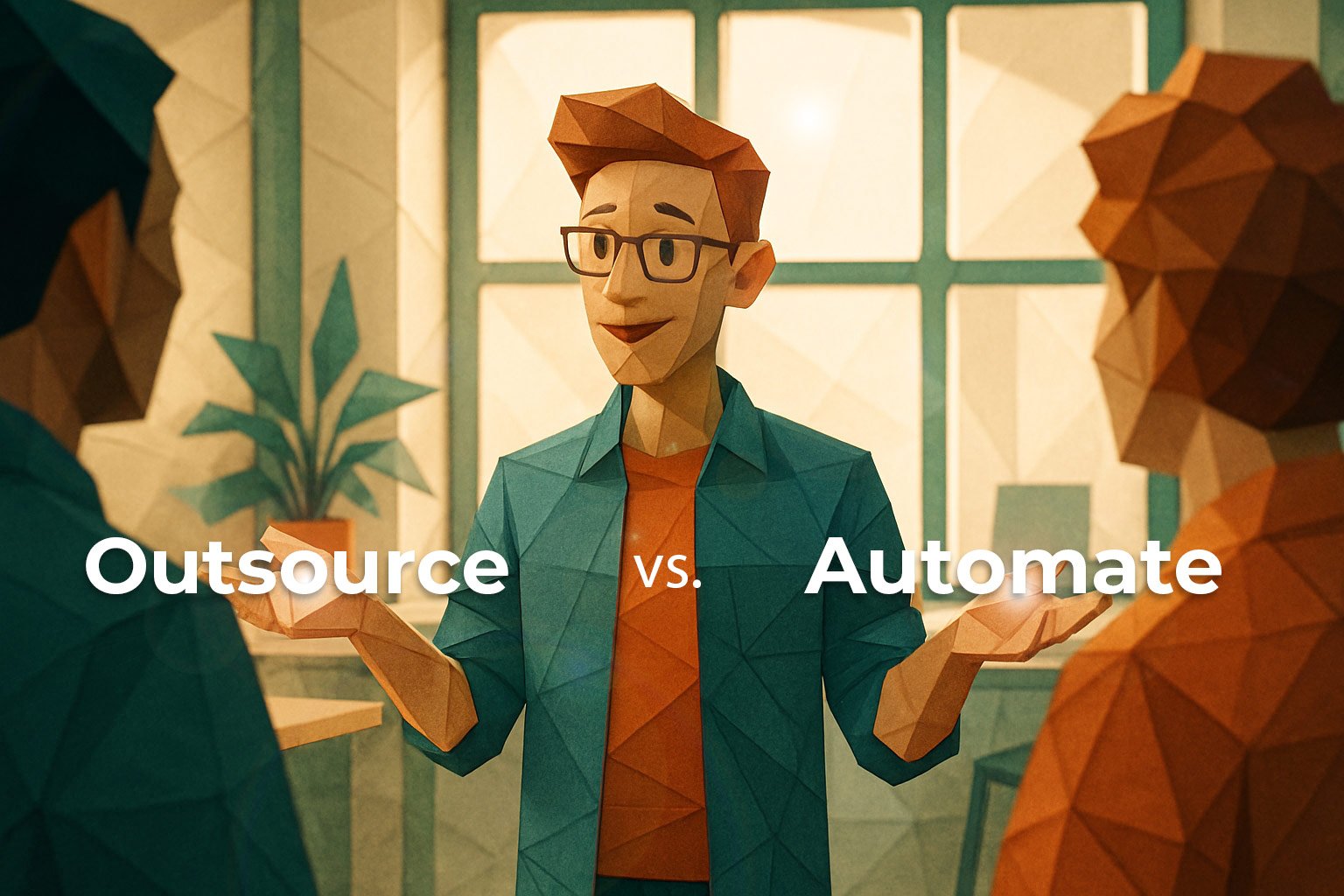
Should I Outsource the Accounts Payable Process or Automate?
Cost savings are a key motivation to outsource accounts payable processes. The same is true for AP automation, which is proven to reduce the cost of processing an invoice up to 80% over manual processing.
AP automation offers many of the same benefits as outsourcing: reduced time spent processing invoices, fewer errors, better insights, smoother accounting processes, and better security.
Related: Template-Free Invoice Processing... Gamechanger for AP Staff
What AP Automation Does Better than AP Outsourcing
- More Control
- More Flexibility
- Better Visibility & Availability of Data
- More Privacy
- Better Audit-tracking
- Tighter Security
What AP Outsourcing Does Better than AP Automation
- No need to manage internal AP staff
- No technology implementation or maintenance responsibility
- Faster to deploy for companies with zero AP infrastructure
- Better suited for companies planning to build AP teams later
Who Is the Best Fit for Outsourcing Payables Processes?
When you outsource accounts payable, the provider handles everything. This is why startups and businesses who want little-to-no AP staff are best suited to outsource accounts payable. Startups can hire their full accounting team later and implement an AP automation solution then.
Who Is the Best Fit for Accounts Payable Automation?
With cloud and software-as-a-service, automation technology is now cost effective and practically effortless to maintain for businesses of any size. Multi-location businesses or businesses who want to grow with a lean accounting team are especially suited to AP automation. However, any business that spends too much time on invoice processing or suffers an AP headache every month-end should consider AP automation.
Key Takeaway
| Choose Outsourcing If... | Choose Automation If... |
|---|---|
| You have no AP staff and don't plan to hire any soon | You have existing AP staff you want to make more efficient |
| You're a startup focused on other priorities | You want to maintain control over your processes and data |
| You have low compliance requirements | You have complex workflows or compliance needs |
| You prefer a fully hands-off approach | You want visibility and flexibility as you scale |
Conclusion
Manual, in-house AP processing is increasingly difficult to scale, particularly given current hiring challenges. Both outsourcing and automation address the core problems of high processing costs, error-prone workflows, and overwhelmed staff. The right choice depends on your organization's size, growth plans, compliance requirements, and how much control you want to retain over your financial processes.
For startups and businesses seeking a fully managed solution with minimal internal involvement, outsourcing is the better fit. For organizations that want to keep AP in-house while dramatically improving efficiency, automation is the stronger choice.