

Microsoft Dynamics 365 Business Central is built for a wide range of business sizes at different stages of growth. Whether your revenue is $1 million, $250 million and even up to $500 million, Business Central is pretty much the accounting solution Microsoft is offering you. That means for some, BC’s native invoice processing functionality might be enough to get by. For more complex organizations with high invoice volume, there comes a point when dedicated Accounts Payable software becomes necessary.
This post covers what BC handles natively for PO matching and AP automation, where the native tools fall short in real world operations, and where Fidesic's MagiCapture extends the platform.
You may also be interested in: From Microsoft Marketplace to Automated: What Business Central Users Need to Know About Native AP Integration
What Business Central Does Natively
BC has built in PO matching functionality, and for many scenarios it works well. Here is what the platform handles out of the box.
Two way and three way matching. BC matches a vendor invoice to a purchase order and, when a receipt has been posted, to the receipt as well. If quantities and unit costs align within configured tolerances, the system allows posting. This covers the basic requirement for most organizations operating in a straightforward procurement environment.
Tolerance settings. Administrators can configure receipt quantity tolerances and cost variance tolerances at general setup, item category, and item levels. This gives finance teams flexibility for minor discrepancies without triggering manual review on every line.
Matching status visibility. Within the purchase invoice card, users can see which lines are matched and which are not. The status is visible at the line level, which helps during manual review.
Invoice hold mechanics. BC can prevent posting of invoices that do not meet matching criteria. This is the core control the feature exists to provide.
Payables Agent for invoice intake. Microsoft released the Payables Agent in fall 2025 with expanded PO matching and three way matching capabilities in version 27.3. The agent monitors a shared Microsoft 365 inbox, picks up vendor invoices as PDFs, creates draft purchase invoices in BC, and suggests account coding based on purchase history.
E Documents and Copilot assisted matching. BC accepts electronic invoices, maps them to vendors through identifiers like VAT registration number, and uses Copilot to match incoming line items against existing PO lines.
Multi line match support. The 2026 wave 1 release added the ability to match purchase invoice lines to multiple PO lines and posted receipt lines, including scenarios with partial receipts, item tracking, and missing receipts.
For organizations with moderate invoice volume, predictable supplier behavior, and staff who live in BC all day, these tools may be sufficient.

Where Business Central's Native Matching Falls Short
The native functionality assumes a clean, linear process. Real AP operations are rarely that. Here is where the gaps appear.
Capture depth is limited on complex invoice formats. The Payables Agent and E Documents features handle clean PDFs and standard electronic invoices reasonably well, but capture accuracy drops on multi page invoices, mixed item types, embedded freight or fee schedules, and non standard vendor layouts. Native OCR also lacks functionality for capturing location codes, dimension data, or cost split rules at the point of capture. Teams with complex invoice formats spend time correcting agent output before matching can run.
Exception handling has limited workflow depth. When an invoice does not match, BC has approval workflows, but customization is limited. Workflows cannot natively route invoice approvals based on location or dimension. Once an exception is flagged, the resolution path is often improvised. Teams fall back to email threads and spreadsheets to manage exceptions, which weakens the audit trail.
Multi entity and multi location operations require add ons. Native BC matching is designed around a single legal entity context. Organizations running multiple companies, multiple locations, or shared service AP teams need approval routing logic and visibility that native workflows do not provide.
Vendor specific matching policy override is shallow. The most granular vendor and item level matching policy override capabilities exist in Dynamics 365 Finance rather than BC. BC's tolerance configuration covers common cases but starts to strain on multi line POs with mixed items, unit of measure conversions, or blanket order structures.
Matching does not unify PO and non PO spend. BC's matching framework is designed around PO backed transactions. The Payables Agent handles non PO invoices by mapping them to GL accounts based on history, but invoices that need department coding, project allocation, or multi dimension splits are weaker. PO and non PO invoices effectively live in parallel processes rather than a unified workflow.
Bulk import and search remain clunky. Bulk importing invoices still relies on templates or external Excel preparation. Searching for specific invoices based on partial data is workable but not as flexible as a purpose built AP tool.
Modern AP automation in BC relies on Copilot and the Payables Agent. Those capabilities are not included in standard BC licensing. They require separate agent licensing and run on a consumption based pricing model tied to AI usage. Costs scale with invoice volume, which makes monthly spend unpredictable and harder to budget against than a flat per user license.
What Fidesic Adds
Fidesic's MagiCapture extends BC where the native experience runs out of operational depth.
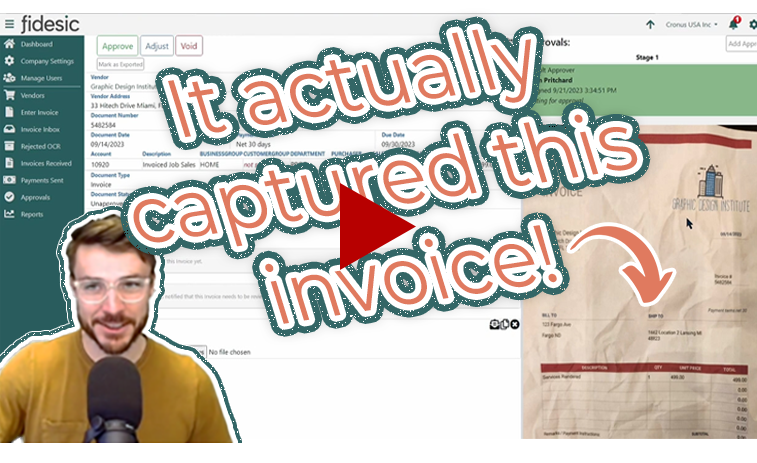
Capture handles complex invoice formats. MagiCapture uses AI to extract structured data from vendor invoices regardless of format, including location codes, dimension data, and line level detail that native OCR misses, giving the matching engine clean data to work with before the invoice is created in BC.
Matching logic is applied automatically at the point of capture. By the time an invoice reaches the BC purchase invoice record, the system has evaluated the PO match, flagged discrepancies, and routed exceptions to the right person. Finance teams are not reviewing matches manually. They are reviewing only what actually needs human judgment.
Exception workflows are built in with full routing depth. When a match fails or falls outside tolerance, MagiCapture routes the exception through a defined approval path that can branch on location, vendor, amount, GL coding, or any dimension the business uses. The resolution is logged. There is a complete audit trail.
Unified handling of PO and non PO spend. Both invoice types move through the same intake, capture, coding, and approval workflow, with dimension splits and project codes applied without a separate process.
Predictable pricing and no extra BC licenses for the people doing capture and approval. With MagiCapture, location managers, department heads, and approvers can capture, code, and approve invoices before anything hits the AP department's desk without needing their own BC user license. Pricing is per invoice, not consumption based, so AP spend is predictable month to month regardless of how heavily the team uses the system.
Conclusion
This post covered what Business Central handles natively for PO matching and AP automation, where the native tools fall short in real world operations, and where Fidesic's MagiCapture extends the platform. BC's native tools may be enough for smaller, lower volume operations, but for organizations with complex invoices, multi location approval needs, or high volume AP, there are some shortcomings in BC that should be taken seriously. For most organizations with multiple locations and heavy invoice volume, a dedicated solution like Fidesic is the only way to truly automate accounts payable.