

It's true that there is some risk in staying on Microsoft Dynamics GP beyond end of support, but the reality is that many users are simply not in a position to move any time soon. This post removes some of the fear around GP end of support and offers practical ways to maximize performance of your GP system.
End of Support Isn't the End of Dynamics GP
Microsoft has published a sunset timeline for Dynamics GP, and many finance teams read that as a signal to stop investing in the system. The reaction is understandable but maybe premature for some. If you can't move to a new system right now, don't panic.
GP is still running payables, receivables, inventory and financials for thousands of organizations, and there is a wide runway left for teams who need to keep improving how they work.
Here is what that runway looks like.
GP Is More Secure Than the Headlines Suggest
Security updates ending is not the same thing as software becoming insecure overnight. GP has been in the field for decades, and every one of those years brought patches and hardening to the same codebase. The result is a mature application with very little low hanging fruit for attackers to leverage.
GP also has a structural advantage. It runs behind your firewall, on your SQL Server, inside your identity perimeter. Most modern attacks target internet facing surfaces, and GP does not present much of one in most cases.
What matters going forward is the environment around GP. Keep Windows Server and SQL Server current and patched. Require MFA on any remote access path. Restrict and audit SQL logins. Test backups and the actual restore process on a schedule. Those controls carry more weight than an application patch ever did.
Consider Moving GP to a Hosted Cloud Environment
For many organizations the fastest security and continuity win is getting GP off aging in house hardware.
Third party GP hosting providers such as Njevity or CyberlinkASP run GP in managed data centers with hardened infrastructure, patched operating systems and SQL versions, monitored access, and tested backup and disaster recovery. Azure IaaS is another route for teams who want to own the virtual machines while retiring the physical ones.
The benefits stack up fast. Remote and hybrid staff get consistent access without VPN headaches. Server refresh cycles leave the capital budget. Uptime and recovery become contractual obligations rather than internal projects. And when a migration eventually happens, your team is already working in a cloud delivered model.
Hosting also buys time in the most literal sense, extending the practical life of a GP environment past the point where local hardware would have forced a decision.
Dexterity Still Makes GP Bend
Dexterity is the proprietary programming language and integrated development environment originally used to build Dynamics GP. It acts as the core engine and architectural layer that manages user interfaces, business logic, and database interactions across different platforms. Dexterity is the reason GP has survived so many business models. It allows changes to forms, tables, business logic and workflow at a depth most cloud ERPs do not permit at any price. If a process is unique to your industry, GP can be shaped around it rather than the other way around.
That flexibility has not expired. Dexterity, Visual Studio Tools, eConnect and the GP SDK all still work, and so do the developers who know them. A customization built this year will run as long as your GP environment does.
Things To Do Inside GP Right Now
Plenty of value sits in the product you already own. Here's what you can do to maximize that value:
- Get to the latest GP version and build. Later releases brought real usability gains and keep you eligible for support while it lasts.
- Audit security roles and tasks. Many installations carry years of over permissioned users.
- Clean up the chart of accounts and inactive master records before anyone talks about migration.
- Rebuild reporting on SmartList Designer, SQL views and Power BI instead of exported spreadsheets.
- Turn on workflow approvals for purchase orders, requisitions and vendor changes.
- Archive historical years to shrink the database and speed up posting.
- Document customizations, integrations and month end steps. This is the highest value task on the list, whether you stay five more years or leave next quarter.
The ISV Ecosystem Is Still Building
Independent software vendors continue to ship real products for GP, and several close gaps GP was never designed to fill.
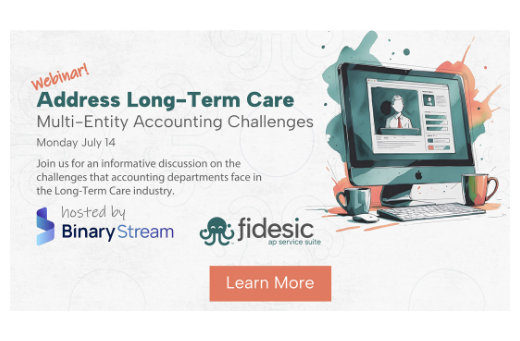
Binary Stream Multi-Entity Management is a perfect example. Organizations running dozens or hundreds of legal entities use it to consolidate into a single GP company, share master records, allocate across entities and produce consolidated financials without maintaining separate databases.
Beyond that, the ecosystem covers most of GP's rough edges. There are solutions for payment security and check processing, integration and data access, bank reconciliation and intercompany posting, data entry and auditing, payroll and compliance, sales tax, document management, expense reporting and receivables.
If a step in your close still runs on spreadsheets and email, an add on probably exists for it. And if the vendor behind a tool you rely on has stopped supporting GP, it's a safe bet that another vendor in the same category likely still does, and switching is usually less disruptive than living with the gap.
AI Is Arriving in GP Through Add Ons
This is where the last few years changed the picture. GP will not receive AI features from Microsoft, but the surrounding tools will, and they connect the same way ISV products always have.
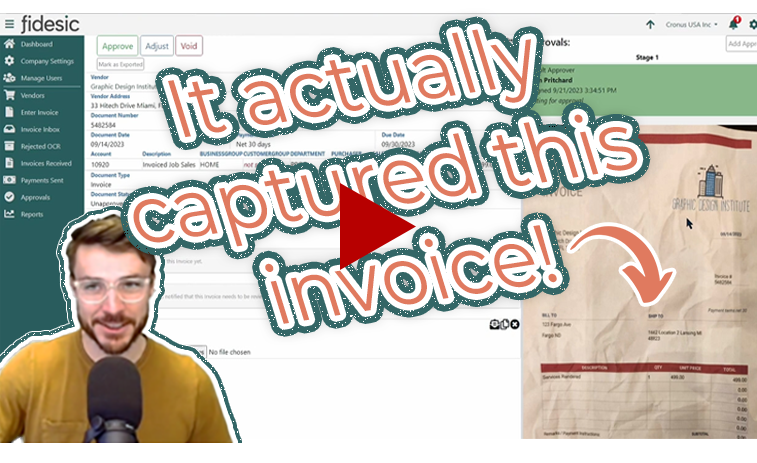
Fidesic brings deployable AI agents to GP accounts payable. Invoices arrive by email or scan, AI powered data capture reads line level detail without templates, and agents handle coding, matching, exception routing and approval reminders. Vendors, GL codes and purchase order data come straight from GP, and posted transactions go back into GP. No migration required, and hosted GP environments work the same way since Fidesic connects over the network rather than depending on a local install.
The pattern holds elsewhere. AI document capture for receivables. Intelligent expense categorization. Anomaly detection over GP data in Power BI or Azure. GP wasn't built for AI but there is AI that has been built for GP.
Conclusion
An end of support date is a planning input, not an emergency. GP customers who spend the next several years upgrading, moving to hosted infrastructure, tightening security, documenting processes and layering automation onto AP and AR will get more out of the system than they have in a decade. They will also arrive at whatever ERP comes next with cleaner data and a clearer picture of what they actually need.
Fidesic was built for GP customers in exactly that position.